Interview With The Author by Lydia E. Penrose for A Graveyard For Gods Irish Horror Anthology
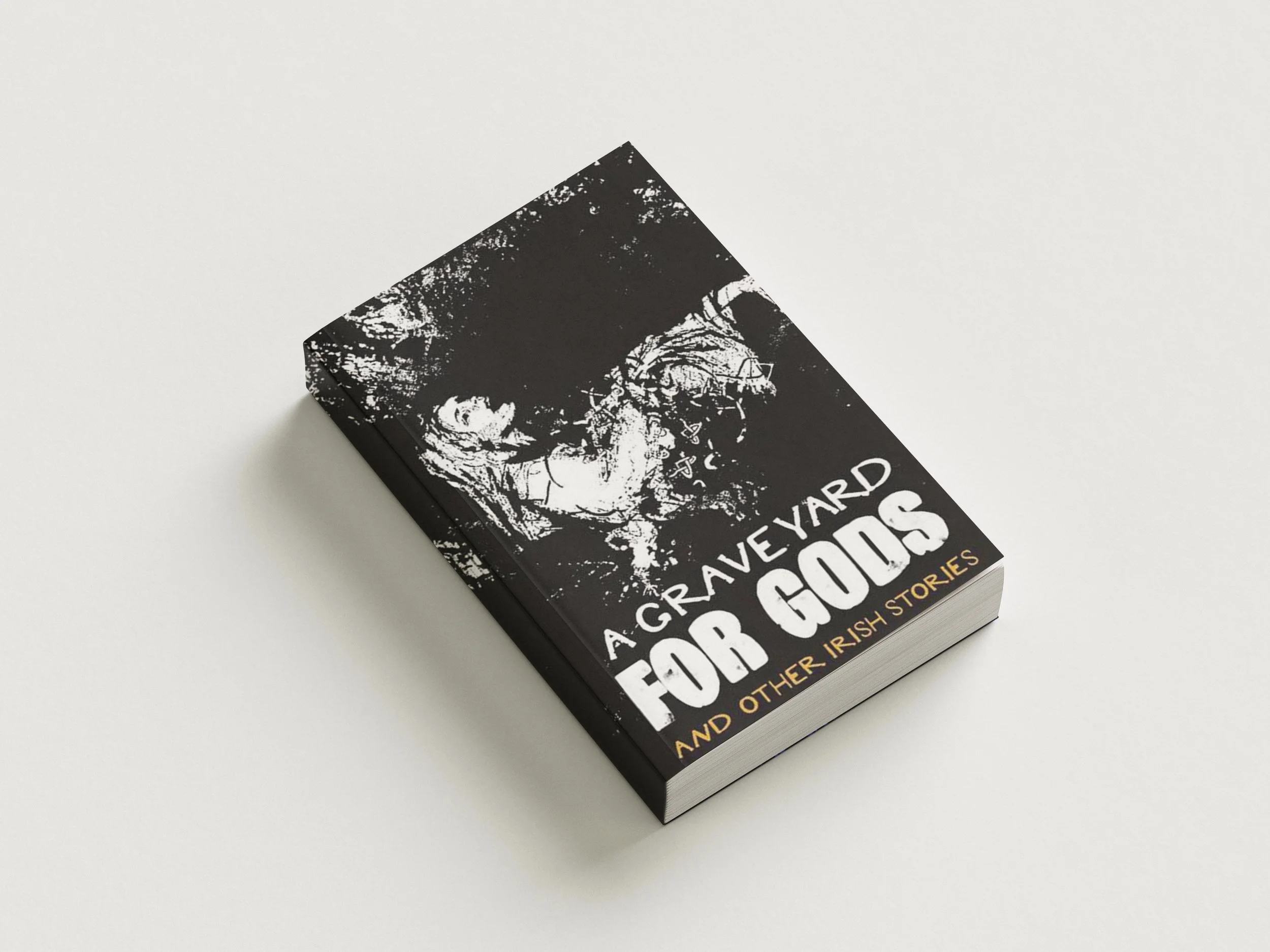
Mock-up image of a paperback book, depicting a black and white illustration of a wailing woman with Celtic inspired designs, bearing the title “A Graveyard For Gods and other Irish stories” on a white background
First tell us about yourself and your writing journey:
Answer: I’m Lulu! I’m from a working class part of Dublin called Ballyfermot, known for “urban cowboys” and having roads named after Joseph Sheridan Le Fanu. I have been writing since I was probably around 7, ever since I begged my parents for a typewriter. I was published in the parish newsletter, doing my hard-hitting reporting on my first communion, haha
Writing was an essential form of escapism for me. Growing up with undiagnosed autism in 90s Ireland made me feel very alienated and out of place, and I always wondered why things couldn’t be like they were in the books I read. I remember doing the “Write A Book Project” in primary school, and being so flattered that people liked what I had written.
Writing shaped me from a young age, as did reading. I initially considered going into journalism, but decided after doing a work experience placement in a newspaper that I didn’t relish the idea of writing whatever my boss wanted me to, usually press releases and puff pieces until they thought that had somehow proven my worth as a writer. I got involved in online collaborative writing groups, making friends with people all around the world that I’m still friends with today.
I ended up in a very weird place after secondary school, and never really figured out what I wanted to do, until I went into tattooing in my mid-twenties. I developed a physical disability/autoimmune disorder at twenty-seven, lost my father to gastric cancer, and felt like my life was over. I ended up coming through that dark time, thanks to some amazing mental health professionals and the inpatient rheumatology treatment at Our Lady’s Hospice. My disability had landed me in a wheelchair due to the pain and fatigue I experienced. I wheeled into the hospice for treatment, and three weeks later I walked out on my own two feet.
I wanted to give back to a service that had helped me so much, so when the opportunity came up to work in CAMHS, I jumped at it. I ran a Dungeons & Dragons game all through that time, and played various tabletop roleplaying games (TTRPGs for short). This really sharpened my sense of writing, in my opinion. Having to adapt to curveballs other players would throw, rather than being in (almost) complete control of a narrative, was fantastic training.
After about 5 years of that, my disability flared up again. I have been focused on my recovery for ages, and only today (30th July), I had my third spinal epidural injection to help with herniated discs. I was fed up with being miserable and in pain so I reached out to my old beloved writing again. Thanks to recent advancements in technology, I’m able to speak out loud directly into my word processing software and have it transcribe what I say with minor editing. I rely on that for bad pain days. On good pain days, I see if my wacky fast touch typing abilities are still up to snuff. Not as good as when I was doing medical dictation in CAMHS, but hey, nobody expects a forty year old athlete to be at their best, either!
I’m also really, truly grateful to have family who support my writing. My fiancé and future mother-in-law are both writers, and have been incredibly supportive and encouraging this whole time. My mother and sister have been my biggest cheerleaders, so it makes a huge difference to have amazing women in my corner, and to have my fiancé by my side throughout my disability and my writing journey.
Question 1: Which Irish mythological figure or legend inspired your story, and what made you choose it?
Answer: I chose the Bean-Nighe, who is typically more associated with Scotland, but she is depicted as an aspect of the Celtic goddess of battle, witchcraft, sovereignty, prophecy and death, who most certainly is associated with Ireland. She is said to wash the armour or clothing of those about to die in battle.
I chose her because in all the writings I have read about the Morrigan, prophecy is not set in stone. It can be evaded, or it may not be, depending on the choices that are made by those who witness their own clothing being washed. She does not kill, she prophecies the death. There’s a huge difference there.
Question 2: How did you approach making old mythology feel fresh and frightening to a modern reader?
Answer: I thought about the fatalistic dark prophecies our brains conjure during serious mental health events, how they can be so certain about what will come to be and why there’s no use fighting what depression or anxiety tells us. I pondered on that a while before realising that all prophecy is that way. It depends on the choices we make. If the Bean-Nighe prophesied that a warrior would die in battle, maybe it’s because the battle tactics they had planned on using would lead to death. Perhaps a better approach is to try a different tactic. Death may occur despite their best attempts, but they went out fighting.
Most people don’t know what it’s like to march to an actual, physical battle. Nowadays, most of us battle with our own thoughts. I think mental health is a modern day war that a lot of readers can relate to and understand. The dread of knowing it can occur to anybody, whether it’s reactive depression or a chemical imbalance in the brain like we see in bipolar or schizophrenia, can be terrifying.
I decided to have the Bean-Nighe with her prophecies of fatalistic certainty cross paths with a young person struggling with their mental health, and to see how that played out.
Question 3: What do you hope readers take away from your story?
Answer: Maybe the true horror wasn’t the mythical creature, but instead it was the thoughts we formed along the way.
Question 4: Were there any traditional elements of Irish folklore you intentionally subverted or reimagined, and why?
Answer: The traditional element of battle, and what it means to take up arms and to be a warrior. There is a famous quote that has been attributed to everyone from Socrates to Robin Williams that says, “Be kind, for everyone you meet is fighting a hard battle you do not know about.” It got me thinking about what battle means in the modern day, and how it doesn’t have to be a literal battle where you wield a sword and shield.
In a battle against cancer, your weapon is chemotherapy or radiotherapy, and your army is modern medicine and your loved ones, while the battlefield is your body. In a battle against mental illness, your weapons are therapy, antidepressants, mood stabilisers, anxiolytics, antipsychotics – whatever you need to get well. The battlefield is your brain, the army is you, your loved ones, and your doctors. I felt that a battle against one’s own mind is truly a terrifying one.
It may not be the Battle of Magh Tuireadh, where multiple people put their bodies on the line, but there are no greater stakes than one’s own survival when the battlefield is one’s own brain.
Question 5: What Irish setting or landscape did you choose for your story, and what does that place bring to the narrative?
Answer: I chose the Furry Glen in the Phoenix Park. It’s a stunning little segment of the park, and named for the abundant moss and greenery that makes it look like plush green fur. It has a waterway in it, that while it technically doesn’t count as a traditional ford, it was always a beautiful place that doesn’t seem like it’s only a few meters away from a main road. There’s something otherworldly about it, and if there was ever a place in Dublin that one of the daoine sídhe would appear in, that’s one place I’d guess.
Water is very much an “in between” place, or thin place. It’s a barrier we can’t survive in for long, so it’s very much a threshold between worlds that we simultaneously need to live. I think water in an enchanted looking place like the Furry Glen is very fitting.
It’s also very close to where the aforementioned Joseph Sheridan Le Fanu lived in Chapelizod, and he was a big influence on my love of horror. I wanted to link it back to him in some way.
Question 6: The Bean-Nighe appears as a catalyst for the protagonist's recovery rather than just doom. How intentional was this subversion?
Answer: Extremely intentional! She’s an aspect of the Morrigan, who is a goddess who calls for battle and blood and death, but in every story we read about her (The Táin, for example) she doesn’t kill outright. She wants those she marks to go out fighting. I thought it was a bit cruel to imply that supernatural forces would target a mentally ill young person for no reason at all. Crucially, the protagonist is respectful to the Bean-Nighe, in stark contrast to Cúchulainn, who was disrespectful to her in The Book of Leinster and she ended up compelling him to break his geas so the prophecy surrounding his death would come to pass.
The protagonist is the polar opposite of Cúchulainn, having none of his confidence or prowess (at least in her own mind). The protagonist has been living under a doom her own brain is trying to convince her is real, so why would the Bean-Nighe find sport or entertainment or even gratification by adding to that? That’s what urged me to make it a subversion.
Question 7: The painting in the story acts as a supernatural mirror. Do you believe art has the power to alter or predict reality, and how did that affect the story?
Answer: So much good art has turned out to be prophecy in disguise over the years. Just look at the Simpsons predicting Donald Trump as president, or Black Mirror predicting horrific modern day realities, or even Jules Verne predicting a space craft from earth landing on the moon all the way back in the 1860s. While these may not have been deliberate prophecies, I believe art and artists can look at the world around us and make predictions of what may come to pass. Sometimes those predictions start out as, “This will be hilarious, isn’t this a silly joke?” and the god Apollo decides to yeet the dodgeball of prophecy at the person who came up with it.
I think sometimes art even has the power to inspire us, like Jules Verne’s work did, to make us think, “Is this something we can one day achieve?” I thought of the Portrait of Dorian Grey, and how his portrait reflects the reality of his soul while his outer self seems beautiful and healthy. I felt this was something of a metaphor for depression and mental health struggles.
The protagonist views the painting and believes it is predicting her reality, the same way people read books or watch films and believe it’s a sign of where the world is going. That’s very often true, but sometimes, especially when struggling with mental illness, it can be a sign of catastrophising.
Question 8: The protagonist struggles with very difficult mental health issues. How do you balance portraying mental illness respectfully while maintaining the tension of supernatural horror?
Answer: Having lived through it myself, I often thought that I would rather take a day with the Cenobites in Hellraiser, facing down a bloodthirsty vampire, or having to run from an onryō than endure a mental health crisis again! Compared with the reality of mental illness, supernatural horror feels oddly easier to face down, if that makes sense? Working in CAMHS, there were literal teenagers who had faced more in their short lives than I think I could have survived, but they still sat in the hospital telling staff, “I can’t complain, other people have it worse than me.”
I tried to remember their struggles while I was writing, and found myself rewriting certain parts out of fear that someone fighting their own mental illness would view something I wrote as an endorsement to hurt themselves or as a condemnation that they were somehow not fighting “hard enough”. I wanted it to give hope, not just horror. Horror can’t exist without the hope of survival, it’s why people fight to survive it in all good horror media. Always those kiddos were in my mind and to a far lesser extent, myself at my worst, whether I would want either of those parties reading it, whether it’s safe for them to read it. It was also vitally important to show that while she was a catalyst for the protagonist to begin recovery, she wasn’t the cause of it. The protagonist has a lot more work to do. We can’t rely on supernatural intervention to save us, we need to do the work. Giving it any other ending risked playing into delusion or even spiritual psychosis, and I couldn’t in good conscience do that.
Question 9: The protagonist ‘discards’ some of her clothes. Why were those specific items (the hoodie and trainers) important to shed?
Answer: They were clothing items the protagonist had worn past the point of real function. They represented a belief that she didn’t believe better, like clinging to an abusive relationship out of fear. These garments were her “armour”, things she had worn for so long in the depths of her depression that they were symbolically soaked in it. Letting them go symbolised releasing the worst parts of her experience, and thus need replacing in some way, with something new and untouched by that reality. It symbolised hope, hope that even though she’s stepping into the complete unknown, she’s putting her faith that even the unknown is better than sticking with a toxic existence. The clothes were a “sacrifice” to the Bean-Nighe, fulfilling the prophecy in a technical sense.